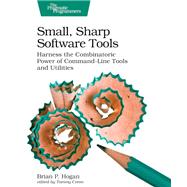
Small Sharp Software Tools
The LASER school is intended for professionals from the industry engineers and managers as well as university researchers including PhD students Participants learn about the most important software technology advances from the pioneers in the field The schools focus is applied although theory is welcome to establish solid foundations The format of the school favors extensive interaction between participants and speakers LASER 2011 is devoted to software verification tools There have been great advances in the field of software verification in recent years Today verification tools are being increasingly used not only by researchers but by programming practitioners The summer school will focus on several of the most prominent and practical of such tools from different areas of software verification such as formal proofs testing and model checking During the school the participants will not only learn the principles behind the tools but also get handson experience trying the tools on real programs
There is currently no description available
This volume constitutes the thoroughly refereed postconference proceedings of the 5th International Conference on Verified Software Theories Tools and Experiments VSTTE 2013 held in Menlo Park CA USA in May 2013 The 17 revised full papers presented were carefully revised and selected from 35 submissions The papers address a wide range of topics including education requirements modeling specification languages specificationverification casestudies formal calculi software design methods automatic code generation refinement methodologies compositional analysis verification tools tool integration benchmarks challenge problems and integrated verification environments
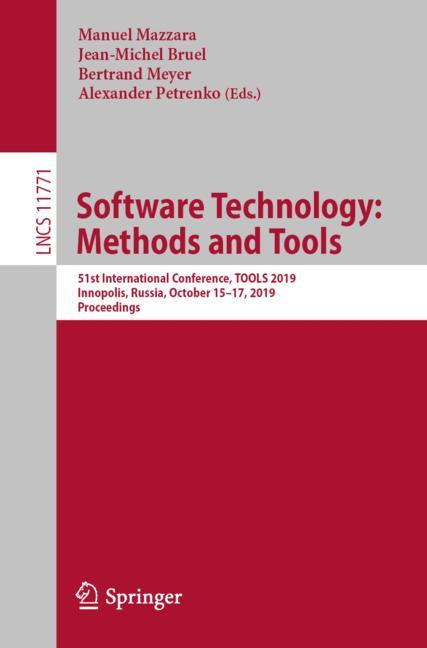
This book constitutes the refereed proceedings of the 51st International Conference on Software Technology Methods and Tools TOOLS 2019 held in Innopolis Russia in October 2019 The 19 revised full papers and 13 short papers presented in this book were carefully reviewed and selected from 62 submissions The papers discuss all aspects of software engineering and programming languages machine learning internet of things security computer architectures and robotics and projects
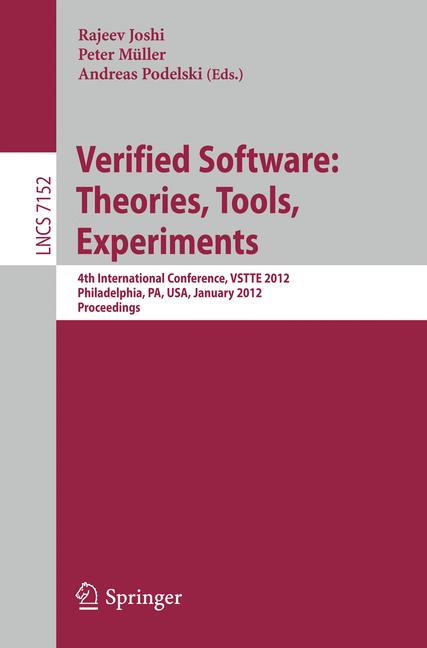
This volume contains the proceedings of the 4th International Conference on Verified Software Theories Tools and Experiments VSTTE 2012 held in Philadelphia PA USA in January 2012 The 20 revised full papers presented together with 2 invited talks and 2 tutorials were carefully revised and selected from 54 initial submissions for inclusion in the book The goal of the VSTTE conference is to advance the state of the art through the interaction of theory development tool evolution and experimental validation The papers address topics such as specification and verification techniques tool support for specification languages tool for various design methodologies tool integration and plugins automation in formal verification tool comparisons and benchmark repositories combination of tools and techniques customizing tools for particular applications challenge problems refinement methodologies requirements modeling specification languages specificationverification casestudies software design methods and program logic
TURBOCHEF TC30219 Eprom Software Version C 3A Sp
This text contains the proceedings of a workshop on software develoDment tools held at Pingree Park Colorado in May 1979 The workshop for which we were cochair men was primarily but not exclusively concerned with a variety of tools supporting preimplementation phases of software development The workshop brought together researchers and practitioners from industrial governmental and academic sectors to compare and assess current work and to set some directions for future work in this emerging technical area The fifty participants represented research and development efforts in software tools within the United States Canada France Great Britain and Japan A list of participants appears at the end of the text Sponsorship was provided by the National Aeronautics and Space Administration the National Bureau of Standards the National Science Foundation and Digital Equipment Corporation The conference consisted of seven formal sessions and numerous organized and impromptu discussions Each session except the last included invited papers prepared remarks by discussants and an open discussion
I am very pleased to write these few brief paragraphs introducing this book and would like to take this opportunity to attempt to set the Toolpack project in an appropriate historical context The Toolpack project must be considered to have actually began in the Fall of 1978 when Prof Webb C Miller at a meeting at Jet Propulsion Laboratories in Pasadena California suggested that there be a largescale project called Toolpack aimed at pulling together a comprehensive collection of mathematical software development tools It was suggested that the project follow the pattern of other Pack projects such as Eispack Linpack and Funpack which had assembled and systematized comprehensive collections of mathematical software in such areas as eigenvalue computation linear equation solution and special function approximation From the that the Toolpack project would differ significantly from beginning it was recognized these earlier Pack projects in that it was attempting to assemble and systematize software in an area which was not well established and understood Thus it was not clear how to organize and integrate the tools we were to collect into Toolpack As a consequence Toolpack became simultaneously a research project and a development project The research was aimed at determining effective strategies for largescale integration of largescale software tools and the development project was aimed at implementing these strategies and using them to put high quality tools at the disposal of working mathematical software writers
This volume contains the proceedings of the second working conference on Verified Software Theories Tools and Experiments VSTTE 2008 held in Toronto Canada in October 2008 The 16 papers presented together with 4 invited talks were carefully revised and selected for inclusion in the book This second conference formally inaugurates the Verified Software Initiative VSI a fifteenyear cooperative international project directed at the scientific challenges of largescale software verification The scope of the cooperative effort includes the sharing and interoperability of tools the alignment of theory and practice the identification of challenge problems the construction of benchmark suites and the execution of largescale experiments
The 2nd edition of this integrated guide explains and lists readily available graphics software tools and their applications while also serving as a shortcut to graphics theory and programming It grounds readers in fundamental concepts and helps them use visualization modeling simulation and virtual reality to complement and improve their work
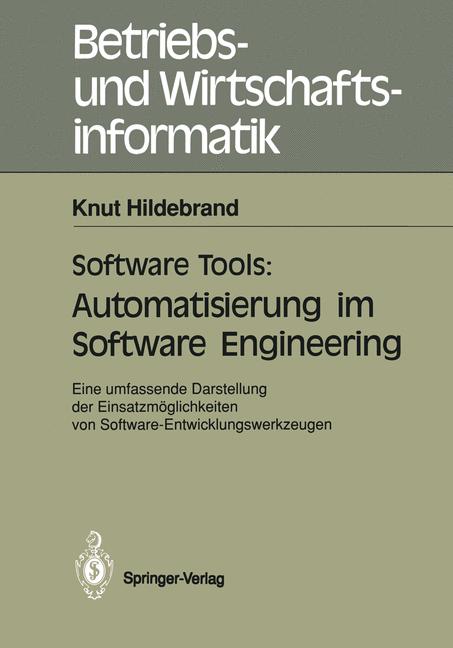
Erstmalig werden in einem Buch Automatisierungspotentiale und Werkzeuge der SoftwareEntwicklung gemeinsam dargestellt Begonnen wird mit einer Analyse der automatisierbaren Tätigkeiten im Software Life Cycle Darauf aufbauend erfolgt die Präsentation einer an den Funktionen und Einsatzbereichen der Software Tools orientierten Systematik sie unterstützt sowohl die theoretische Einordnung als auch die praxisorientierte Auswahl der Programmierwerkzeuge Parallel dazu werden die wesentlichen Eigenschaften der Werkzeuge auf der Basis einer vereinheitlichten Terminologie erläutert Dadurch erhält der Leser einen umfassenden Überblick über Funktionen und Einsatzbereiche von Software Tools incl Fourth Generation Languages 4GLs der auch weniger gebräuchliche Tools mit teilweise ungewöhnlichen Funktionen berücksichtigt
This text contains the proceedings of a workshop on software develoDment tools held at Pingree Park Colorado in May 1979 The workshop for which we were cochair men was primarily but not exclusively concerned with a variety of tools supporting preimplementation phases of software development The workshop brought together researchers and practitioners from industrial governmental and academic sectors to compare and assess current work and to set some directions for future work in this emerging technical area The fifty participants represented research and development efforts in software tools within the United States Canada France Great Britain and Japan A list of participants appears at the end of the text Sponsorship was provided by the National Aeronautics and Space Administration the National Bureau of Standards the National Science Foundation and Digital Equipment Corporation The conference consisted of seven formal sessions and numerous organized and impromptu discussions Each session except the last included invited papers prepared remarks by discussants and an open discussion
Erstmalig werden in einem Buch Automatisierungspotentiale und Werkzeuge der SoftwareEntwicklung gemeinsam dargestellt Begonnen wird mit einer Analyse der automatisierbaren TÃtigkeiten im Software Life Cycle Darauf aufbauend erfolgt die PrÃsentation einer an den Funktionen und Einsatzbereichen der Software Tools orientierten Systematik sie unterstÃtzt sowohl die theoretische Einordnung als auch die praxisorientierte Auswahl der Programmierwerkzeuge Parallel dazu werden die wesentlichen Eigenschaften der Werkzeuge auf der Basis einer vereinheitlichten Terminologie erlÃutert Dadurch erhÃlt der Leser einen umfassenden Ãberblick Ãber Funktionen und Einsatzbereiche von Software Tools incl Fourth Generation Languages 4GLs der auch weniger gebrÃuchliche Tools mit teilweise ungewÃhnlichen Funktionen berÃcksichtigt
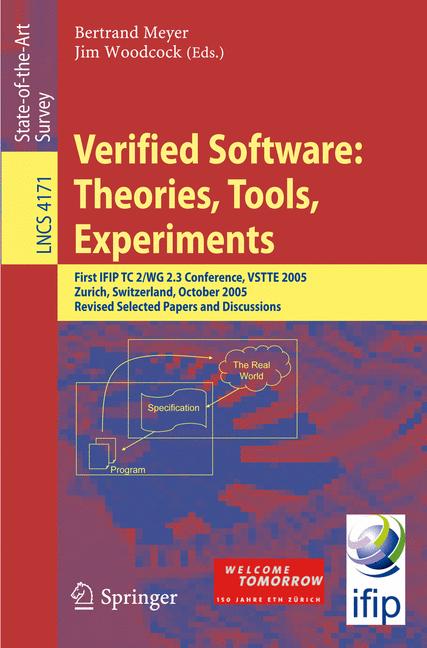
A Step Towards Verified Software Worries about the reliability of software are as old as software itself techniques for allaying these worries predate even James Kings 1969 thesis on A program verifier What gives the whole topic a new urgency is the conjunction of three phenomena the blitzlike spread of softwarerich systems to control ever more facets of our world and our lives our growing impatience with deficiencies and the developmentproceeding more slowly alas than the other two trendsof techniques to ensure and verify software quality In 2002 Tony Hoare one of the most distinguished contributors to these advances over the past four decades came to the conclusion that piecemeal efforts are no longer sufficient and proposed a Grand Challenge intended to achieve over 15 years the production of a verifying compiler a tool that while processing programs would also guarantee their adherence to specified properties of correctness robustness safety security and other desirable properties As Hoare sees it this endeavor is not a mere research project as might normally be carried out by one team or a small consortium of teams but a momentous endeavor comparable in its scope to the successful mission to send a man to the moon or to the sequencing of the human genome
A Step Towards Verified Software Worries about the reliability of software are as old as software itself techniques for allaying these worries predate even James Kingâs 1969 thesis on âA program verifier â What gives the whole topic a new urgency is the conjunction of three phenomena the blitzlike spread of softwarerich systems to control ever more facets of our world and our lives our growing impatience with deficiencies and the developmentâproceeding more slowly alas than the other two trendsâof techniques to ensure and verify software quality In 2002 Tony Hoare one of the most distinguished contributors to these advances over the past four decades came to the conclusion that piecemeal efforts are no longer sufficient and proposed a âGrand Challengeâ intended to achieve over 15 years the production of a verifying compiler a tool that while processing programs would also guarantee their adherence to specified properties of correctness robustness safety security and other desirable properties As Hoare sees it this endeavor is not a mere research project as might normally be carried out by one team or a small consortium of teams but a momentous endeavor comparable in its scope to the successful mission to send a man to the moon or to the sequencing of the human genome
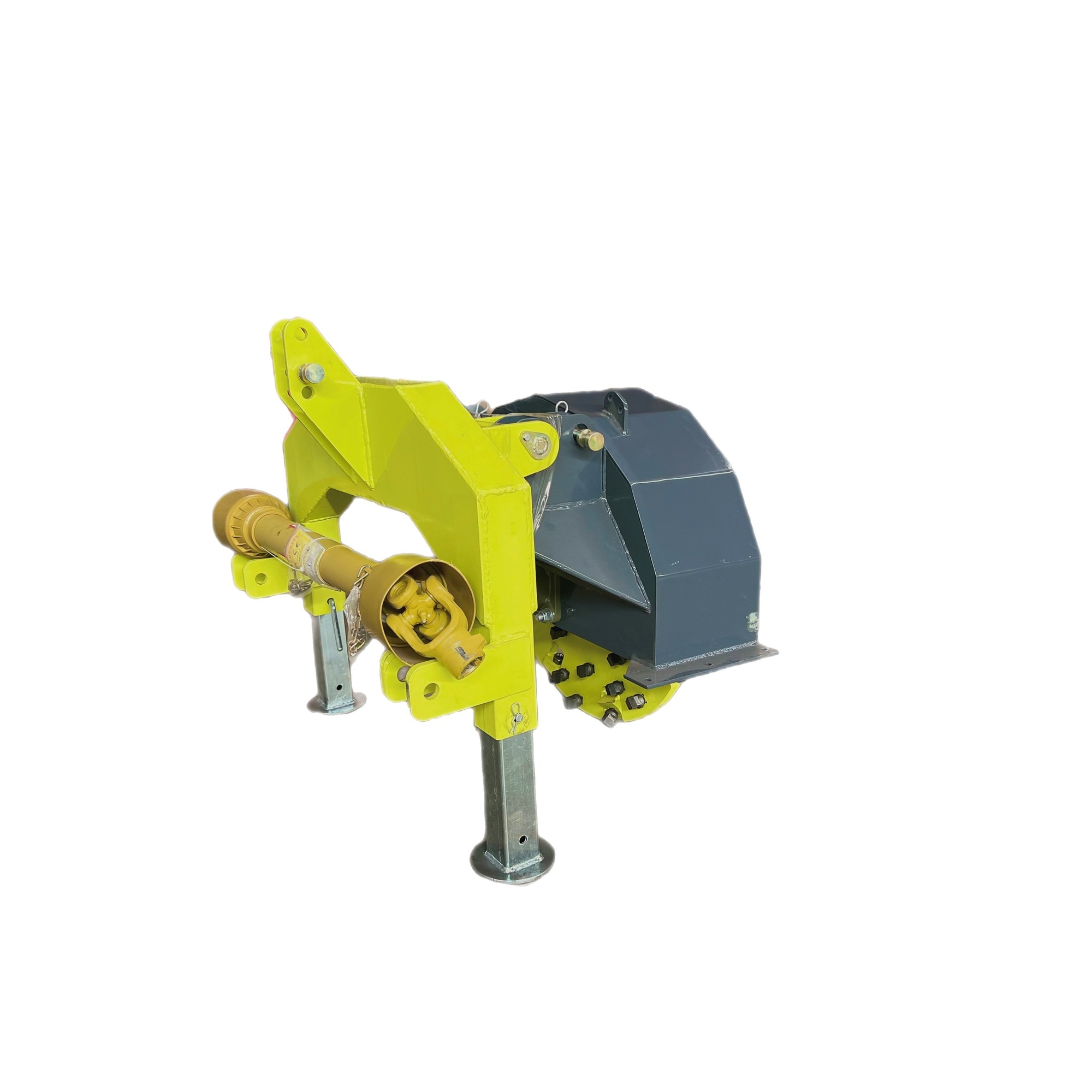
Timber TuffÂs newest 3Point Accessory is the TMG243PT Stump Grinder This stump grinder has a 24Â diameter cutter wheel and works with category 1 tractors It works with 2045 HP motors and has its own PTO driven power at 540 RPM Timber TuffÂs Stump Grinder is designed with 34 carbide teeth to resist wear from rocks dirt wood etc This stump grinder grinds to 6Â below ground level to give you a nice smooth surface The heavyduty carbon alloy construction is durable and long lasting This is the perfect tool to easily remove stumps down to the roots It clears stumps and prepares your yard or field for sod planting grading and more This method is less damaging to your yard than alternate methods Using the stump grinder also has the added benefit of preventing insect wood bee and other pests from infesting your stumps and becoming a problem This Timber Tuff tool includes a slip clutch PTO for added safety 24Â diameter cutter wheel 3PT attachment works with Category 1 tractors 540 RPM Â PTO driven power Works with 2045 HP Designed with 34 carbide teeth Grinds to 6Â below ground level Heavyduty carbon alloy construction Removes stumps down to the roots Clears stumps and prepares the yardfield for sod planting grading etc Less damaging to your yard than alternate methods Prevents insect wood bee and other pests from infesting your stumps Includes a slip clutch PTO for added safety 1 year limited manufacturerÂs parts warranty