by Ricky Tucker PRINT ISBN 9780807003480 ETEXT ISBN 9780807003497 Additional ISBNs 9780807094501 9780807094471 9780807007327
Theyre as heavy as a battleship yet the songs are meticulously structured skillfully balancing thrash beats New Wave of British Heavy Metal rhythms punk metal attitude blistering and ferocious dual guitar work and scarinflicting vocals Its all about big verses and big songs Category 7s selftitled debut is available on digital platforms CD and LP Produced engineered mixed and mastered by Mike Orlando Sonic Stomp Studios Art and layout by Carlos Fides at Artside Studio Angra Evergrey Kamelot Videos directed by Tom Flynn and Mike Watts Produced by Jay Tavernese Lamb of God
This Unique Item Stands Out With Its Striking Black And White Color Scheme Offering A Versatile Addition To Any Collection Its Design Is Tailored To Fit Into The Other Category Making It A Distinctive Choice For Those Seeking Something Different
Category Font Family was designed by Adam Roe and published by Monotype Category contains 2 styles and family package options
There is currently no description available
The papers in this volume were presented at the fourth biennial Summer Conference on Category Theory and Computer Science held in Paris September36 1991 Category theory continues to be an important tool in foundationalstudies in computer science It has been widely applied by logicians to get concise interpretations of many logical concepts Links between logic and computer science have been developed now for over twenty years notably via the CurryHoward isomorphism which identifies programs with proofs and types with propositions The triangle category theory logic programming presents a rich world of interconnections Topics covered in this volume include the following Type theory stratification of types and propositions can be discussed in a categorical setting Domain theory synthetic domain theory develops domain theory internally in the constructive universe of the effective topos Linear logic the reconstruction of logic based on propositions as resources leads to alternatives to traditional syntaxes The proceedings of the previous three category theory conferences appear as Lecture Notes in Computer Science Volumes 240 283 and 389
This book presents the proceedings of the Sixth International Conference on Category Theory and Computer Science CTCS 95 held in Cambridge UK in August 1995 The 15 revised full papers included in the volume document the exploitation of links between logic and category theory leading to a solid basis for much of the understanding of the semantics of computation Notable amongst other advances is the introduction of linear logic and other substructural logics providing a new approach to proof theory Further aspects covered are semantics of lambda calculi and type theories program specification and development and domain theory
This book constitutes the refereed proceedings of the 7th International Conference on Category Theory and Computer Science CTCS97 held in Santa Margheria Ligure Italy in September 1997 Category theory attracts interest in the theoretical computer science community because of its ability to establish connections between different areas in computer science and mathematics and to provide a few generic principles for organizing mathematical theories This book presents a selection of 15 revised full papers together with three invited contributions The topics addressed include reasoning principles for types rewriting program semantics and structuring of logical systems
Strategic Sourcing and Category Management
In this edition a set of Supplementary Notes and Remarks has been added at the end grouped according to chapter Some of these call attention to subsequent developments others add further explanation or additional remarks Most of the remarks are accompanied by a briefly indicated proof which is sometimes different from the one given in the reference cited The list of references has been expanded to include many recent contributions but it is still not intended to be exhaustive John C Oxtoby Bryn Mawr April 1980 Preface to the First Edition This book has two main themes the Baire category theorem as a method for proving existence and the duality between measure and category The category method is illustrated by a variety of typical applications and the analogy between measure and category is explored in all of its ramifications To this end the elements of metric topology are reviewed and the principal properties of Lebesgue measure are derived It turns out that Lebesgue integration is not essential for present purposesthe Riemann integral is sufficient Concepts of general measure theory and topology are introduced but not just for the sake of generality Needless to say the term category refers always to Baire category it has nothing to do with the term as it is used in homological algebra
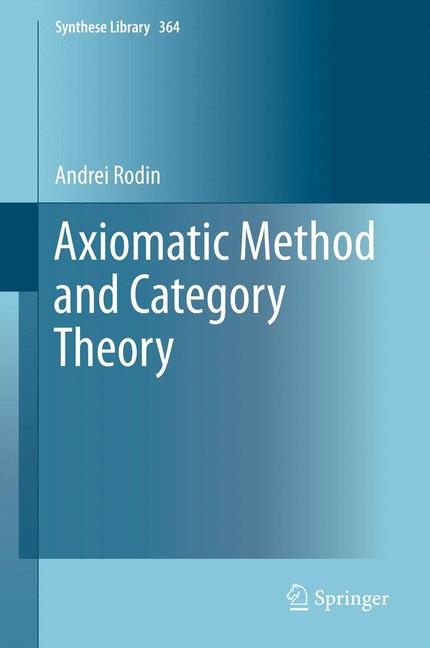
This volume explores the many different meanings of the notion of the axiomatic method offering an insightful historical and philosophical discussion about how these notions changed over the millennia The author a wellknown philosopher and historian of mathematics first examines Euclid who is considered the father of the axiomatic method before moving onto Hilbert and Lawvere He then presents a deep textual analysis of each writer and describes how their ideas are different and even how their ideas progressed over time Next the book explores category theory and details how it has revolutionized the notion of the axiomatic method It considers the question of identityequality in mathematics as well as examines the received theories of mathematical structuralism In the end Rodin presents a hypothetical New Axiomatic Method which establishes closer relationships between mathematics and physics Lawveres axiomatization of topos theory and Voevodskys axiomatization of higher homotopy theory exemplify a new way of axiomatic theory building which goes beyond the classical Hilbertstyle Axiomatic Method The new notion of Axiomatic Method that emerges in categorical logic opens new possibilities for using this method in physics and other natural sciences This volume offers readers a coherent look at the past present and anticipated future of the Axiomatic Method